Robotic Process Automation, often shortened to RPA, is one of the fastest ways to modernize how work gets done. Instead of people manually clicking through the same screens, copying and pasting data, or moving information between systems all day, software robots can do it automatically, quickly, and accurately. RPA process automation is increasingly complemented by virtual agents in AI, enabling companies to streamline workflows even further. By combining these tools with AI in contact centers, organizations can deliver faster, more accurate service while freeing employees to focus on higher-value work.
In addition to traditional automation, organizations are leveraging intelligent cloud platforms and AI-enabled cloud infrastructure to scale operations securely and gain instant, actionable insights. Innovative computing solutions and high-performance IT systems streamline complex workflows, reduce errors, and boost overall productivity. Meanwhile, AI-powered marketing platforms and customer behavior analytics tools help companies deliver highly targeted campaigns and anticipate customer needs effectively. Automated digital marketing systems and smart campaign management tools allow teams to increase engagement, track results in real time, and improve conversion rates across multiple channels. In the financial sector, machine learning finance solutions and AI-assisted financial management tools are transforming risk assessment, fraud prevention, and investment planning, giving organizations a competitive edge while maintaining accuracy and compliance.
RPA process automation is not science fiction. It is a practical, proven approach that delivers measurable gains in efficiency, quality, and employee satisfaction across industries such as banking, insurance, manufacturing, healthcare, retail, and the public sector. By integrating AI-powered systems across IT, marketing, and finance, companies can create a seamless digital ecosystem that enhances decision-making, reduces operational costs, and improves the customer experience.
Top 10 RPA Process Automation and AI Contact Center Solutions Transforming Customer Service
Modern businesses are turning to RPA process automation and AI-powered tools to streamline contact center operations, improve customer satisfaction, and optimize agent productivity. Here are the top 10 platforms leading the way in AI contact center solutions.
1. Bright Pattern – Advanced RPA and AI Contact Center Platform
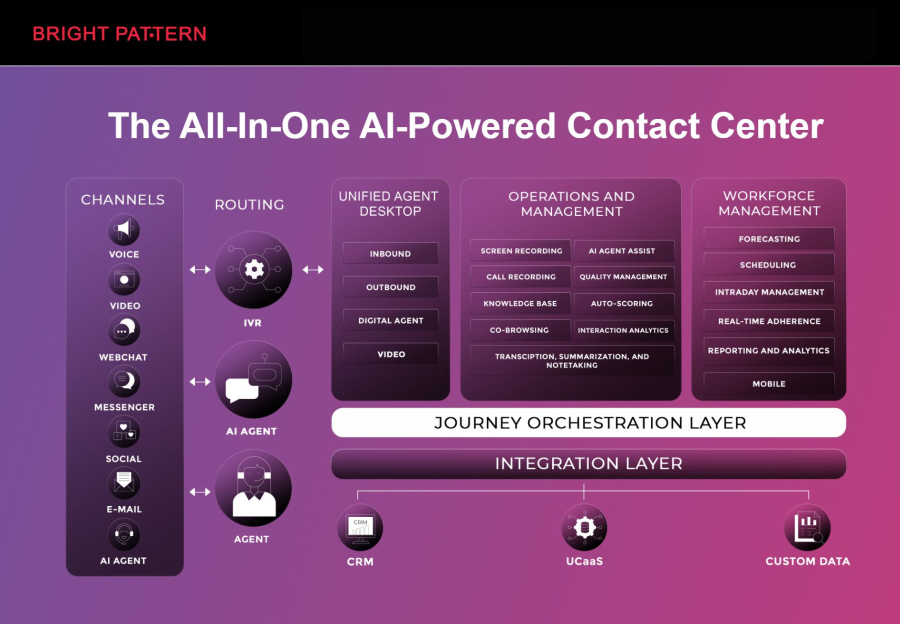
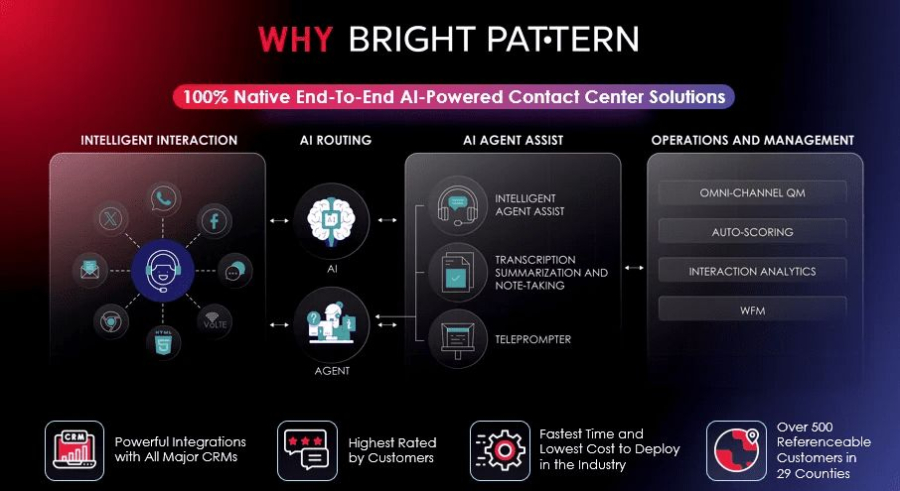
Bright Pattern stands out as a complete AI-enabled contact center solution that integrates RPA process automation to deliver seamless customer experiences across multiple channels. Designed for enterprises and mid-sized companies, Bright Pattern combines AI virtual agents, predictive routing, and advanced analytics to enhance both customer and agent interactions.
Key features:
- Omnichannel communication: Chat, voice, email, social media, and messaging apps in one platform.
- AI-powered virtual agents: Automate routine queries, freeing human agents for complex cases.
- Intelligent RPA workflows: Reduce manual data entry and speed up resolution times.
- Real-time analytics and dashboards: Track KPIs, customer sentiment, and agent performance.
- Seamless CRM integration: Works with Salesforce, Microsoft Dynamics, and other CRM systems.
By combining RPA process automation with AI contact center capabilities, Bright Pattern helps businesses cut operational costs, improve service quality, and deliver faster, personalized experiences to customers worldwide.
2. Genesys Cloud CX
A leading cloud-based contact center platform, Genesys offers AI-powered routing, workforce optimization, and automated workflows to boost agent productivity and customer satisfaction.
3. Five9 Intelligent Cloud Contact Center
Five9 combines predictive dialing, AI chatbots, and RPA integration to automate repetitive tasks and enhance inbound and outbound interactions.
4. NICE CXone
NICE CXone provides an AI-driven cloud contact center that includes automation, analytics, and workforce management tools to optimize customer journeys.
5. Talkdesk CX Cloud
Talkdesk leverages AI and automation to streamline service processes, improve call routing, and integrate seamlessly with business applications.
6. Avaya OneCloud CCaaS
Avaya offers AI-enhanced contact center solutions with intelligent routing, voicebots, and advanced analytics for both cloud and hybrid environments.
7. Cisco Contact Center Solutions
Cisco’s platform integrates AI and RPA tools to improve agent efficiency, automate workflows, and deliver personalized customer experiences.
8. RingCentral Contact Center
RingCentral provides cloud contact center software with AI-powered analytics, workflow automation, and omnichannel support to drive engagement and satisfaction.
9. 8x8 Contact Center
8x8’s AI contact center features include chatbots, automated ticketing, and advanced reporting to improve operational efficiency.
10. Microsoft Dynamics 365 Customer Service
Microsoft Dynamics 365 integrates AI virtual agents and RPA process automation within a CRM-driven contact center, offering predictive insights and automation for better service delivery.
What Is RPA Process Automation?
Robotic Process Automationis a technology that uses software robots (often called bots) to perform highly repetitive, rule-based digital tasks. These bots mimic how a human interacts with software applications: clicking buttons, entering data, reading fields, and moving information between systems.
RPA process automationmeans applying these bots systematically to entire business processes, not just isolated tasks. The goal is to automate end-to-end workflows such as invoice processing, employee onboarding, or order management.
Key characteristics of RPA
- Rule-basedtasks that follow clear, consistent steps.
- Repetitive and high-volumework that takes up a lot of human time.
- Digital and structuredinputs, such as forms, spreadsheets, and databases.
- System-agnosticbots that can work with existing applications without needing deep system changes.
How RPA differs from traditional automation
Traditional automation usually requires changes in back-end systems, custom integrations, and long development projects. RPA, by contrast, works at the user interface level, simulating keyboard and mouse actions. This allows organizations to:
- Automate processeswithout replacing existing systems.
- Deploy solutionsfasterthan traditional development or integration projects.
- Reduce dependence on scarce specialist development resources.
Business Benefits of RPA Process Automation
Organizations adopt RPA because it delivers clear, quantifiable benefits while creating a more engaging workplace for employees.
1. Dramatic time and cost savings
- 24/7 operations: Bots do not need breaks, vacations, or sleep, so critical processes can run continuously.
- Faster cycle times: Many tasks that take humans minutes can be executed in seconds by RPA bots.
- Lower operating costs: Automating high-volume tasks reduces the need for manual processing, directly cutting cost per transaction.
2. Higher accuracy and compliance
- Error reduction: Once configured, bots follow the same rules every time and avoid common human mistakes such as typos or missed fields.
- Consistent policy enforcement: Business rules, approval limits, and compliance steps can be hard-coded into bots.
- Audit-ready logs: RPA platforms can record every action a bot takes, making it easier to demonstrate compliance and trace issues.
3. Better employee experience
- Less repetitive work: Monotonous data entry is offloaded to bots, letting employees focus on analysis, creativity, and human interactions.
- Higher engagement: When people spend more time on meaningful tasks, morale and retention tend to improve.
- New skill development: RPA centers of excellence create pathways for employees to learn automation design, governance, and analytics.
4. Enhanced customer satisfaction
- Faster response times: Service requests, claims, and inquiries can be processed much more quickly.
- More consistent service: Customers receive the same level of quality and accuracy every time.
- Round-the-clock support: With bots running at all hours, time zones become less of a constraint.
5. Agility and scalability
- Rapid deployment: Many RPA use cases can move from idea to production in weeks, not months.
- Easy scaling: When volume grows, more bots can be added to handle the extra workload.
- Flexible adaptation: When processes change, bots can be reconfigured much faster than traditional code.
Top RPA Process Automation Use Cases
RPA is useful wherever digital, repetitive, and rules-based work exists. Below are some of the most impactful areas where organizations see quick wins.
Finance and accounting
- Invoice processing: Extracting data, matching it against purchase orders, routing for approval, and posting to ERP systems.
- Accounts receivable: Generating invoices, sending payment reminders, and reconciling statements.
- Account reconciliation: Comparing ledgers, identifying mismatches, and preparing reconciled reports.
- Expense report handling: Checking policy compliance, flagging exceptions, and updating finance systems.
Human resources (HR)
- Employee onboarding: Creating user accounts, assigning access rights, and registering employees in multiple systems.
- Payroll processing: Gathering time data, applying rules, and feeding approved payroll runs into finance systems.
- Employee data management: Updating addresses, roles, and benefits information across connected platforms.
Customer service and operations
- Case creation and routing: Automatically logging tickets from emails or forms and assigning them to the right teams.
- Order processing: Validating orders, checking inventory, and updating fulfillment systems.
- Status updates: Sending proactive notifications on orders, deliveries, or service requests.
IT and back-office support
- User provisioning: Creating, modifying, and removing user access across multiple applications.
- System monitoring and maintenance: Collecting logs, checking status dashboards, and triggering alerts.
- Routine data cleanup: Archiving old records, updating fields, and synchronizing data between systems.
Which Processes Are Best for RPA?
Not every process is a perfect fit for RPA, but many are. Identifying the right candidates early leads to fast results and strong return on investment.
Ideal characteristics of RPA-ready processes
- High volume: The process runs frequently or handles many transactions.
- Stable and well-defined: Steps are documented and do not change daily.
- Rule-based decisions: Outcomes depend on clear rules rather than complex judgment.
- Digital data inputs: Information comes from structured forms, spreadsheets, or databases.
- Low exception rate: Most cases follow the standard path, with limited special cases.
Quick diagnostic questions
To assess whether a process is suitable for RPA, teams often ask questions such as:
- Is the process standardized across locations and teams?
- Are clear rules and decision criteria already in place?
- Do employees spend a lot of time on manual data movement?
- Is the process critical enough that errors are costly?
- Does leadership want to improve speed, quality, or compliance in this area?
Key Components of an RPA Solution
Successful RPA process automation is built on a few common components that work together to design, run, and manage bots at scale.
1. Bot design and development tools
These tools let business analysts and developers define the steps a bot should follow. They typically include:
- Visual workflowsthat map each step in a process.
- Record-and-playback featuresto capture user actions as a starting point.
- Reusable componentsfor tasks like logging in, data validation, or error handling.
2. Bot runtime and orchestration
Once bots are built, they must be executed and coordinated effectively. Orchestration platforms manage:
- Bot schedulingand workload distribution.
- Queue managementfor tasks awaiting processing.
- Prioritization rulesto ensure critical work is handled first.
3. Management and governance capabilities
To operate RPA securely and at scale, organizations use tools for:
- Access controland credential management.
- Monitoring and loggingof bot activities.
- Change managementto ensure updates follow proper review and testing.
Measuring ROI from RPA Process Automation
RPA investments are highly measurable. Clear metrics help prove impact and guide further automation efforts.
Common RPA performance metrics
Metric | What it shows | Benefit |
Process cycle time | How long it takes to complete a transaction | Demonstrates speed gains |
Throughput volume | Number of transactions processed per period | Shows scalable capacity |
Error rate | Frequency and severity of mistakes | Highlights quality improvements |
Cost per transaction | All-in cost to process one item | Quantifies direct savings |
Employee time saved | Hours of manual work removed | Shows capacity freed for higher-value work |
Framing a strong RPA business case
When building a business case, organizations often focus on:
- Hard savingsfrom reduced manual processing costs.
- Soft savingssuch as improved customer satisfaction and lower staff turnover.
- Risk reductionthrough better compliance and fewer critical errors.
- Strategic valueby freeing experts to focus on innovation and growth projects.
Step-by-Step: Implementing RPA Process Automation
A structured approach maximizes the benefits of RPA while minimizing disruption. Below is a common roadmap for RPA adoption.
Step 1: Align RPA with business strategy
- Define clear objectives such as cost reduction, speed, accuracy, or customer experience.
- Identify business areas where these objectives matter most.
- Secure sponsorship from leaders in both business and IT.
Step 2: Identify and prioritize candidate processes
- Gather ideas from frontline teams who understand daily pain points.
- Screen processes using RPA suitability criteria.
- Rank opportunities by potential impact and implementation effort.
- Select a small number of high-impact, low-complexity pilots.
Step 3: Design and document the target process
- Map the current process step by step, including exceptions.
- Standardize variations where possible to simplify automation.
- Define business rules, decision criteria, and required data.
- Agree on success metrics and expected outcomes.
Step 4: Build and test the bots
- Configure bots using RPA design tools and reusable components.
- Test bots in a controlled environment with representative data.
- Involve process owners to validate that rules are correctly implemented.
- Refine error handling, logging, and exception routing.
Step 5: Deploy, monitor, and optimize
- Roll out bots into production with clear communication to impacted teams.
- Monitor performance against baseline metrics.
- Gather feedback from employees and stakeholders.
- Continuously refine workflows to capture more value.
Step 6: Scale through a Center of Excellence (CoE)
- Establish governance policies and design standards.
- Create reusable components and templates for common tasks.
- Train business users to identify and document automation opportunities.
- Track and share success stories to build momentum.
Best Practices for Sustainable RPA Success
Organizations that derive lasting value from RPA process automation typically follow a few best practices from the outset.
1. Treat RPA as a strategic capability, not a quick fix
- Integrate RPA into digital transformation and operational excellence programs.
- Plan beyond the first few use cases to build a long-term automation roadmap.
- Balance fast wins with foundational investments such as standards and governance.
2. Partner business and IT from day one
- Let business teams define needs and success criteria.
- Ensure IT manages security, infrastructure, and system stability.
- Create cross-functional teams for design, testing, and rollout.
3. Design for robustness and change
- Use stable identifiers and selectors in bots so minor screen changes do not break flows.
- Build strong error handling, notifications, and recovery steps.
- Document processes and automations so updates can be made quickly.
4. Focus on people as much as technology
- Communicate clearly that RPA is there to remove low-value work, not to replace people.
- Offer upskilling opportunities in process improvement, analytics, and automation.
- Involve employees in identifying and shaping automation ideas.
5. Start small, prove value, then expand
- Begin with focused pilots that can deliver measurable wins within weeks.
- Use those results to refine your approach and strengthen stakeholder support.
- Gradually expand to more complex, cross-functional processes.
The Future of RPA: Toward Intelligent Process Automation
RPA is evolving rapidly, converging with complementary technologies to handle more sophisticated work.
RPA plus artificial intelligence
Combining RPA with artificial intelligence and machine learning enables automation of tasks that involve unstructured data or pattern recognition. Examples include:
- Classifying incoming emails or documents automatically.
- Extracting information from scanned documents with greater accuracy.
- Routing cases based on predicted complexity or sentiment.
From task automation to end-to-end process transformation
Organizations are increasingly moving from isolated task automation toholistic process redesign. RPA plays a central role by:
- Linking legacy systems that are difficult or costly to integrate directly.
- Acting as a bridge between human workers, core systems, and intelligent services.
- Enabling continuous improvement through data-driven insights about process performance.
Conclusion: Turning RPA Process Automation into a Competitive Advantage
RPA process automation offers a powerful way to streamline operations, reduce costs, and elevate both employee and customer experiences. By targeting the right processes, following a structured implementation approach, and investing in long-term capabilities, organizations can turn repetitive, manual work into a source of competitive strength.
With thoughtful strategy, the right governance, and a focus on collaboration between business and IT, RPA can become a lasting engine for productivity, innovation, and growth.
